
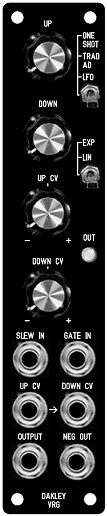
The Oakley
Versatile Ramp Generator (VRG) is a single width 5U high module
that can function as a voltage controlled variable symmetry
oscillator, a traditional attack-decay envelope generator, a one
shot transient generator with patch programmed repeat, a voltage
controlled slew generator, a gate delay and an audio filter. The
output slope can be either linear or exponential.
The output
signal will rise at a rate determined by the UP control and the
up control voltage input. The output signal will fall at a rate
determined by the DOWN control and the down control voltage input.
An additional
output is available called NEG OUT. This output is a gate style
signal that is 0V when off and +5V when activated. It will be
activated when the main output falls below 600mV. This can be
used as an ‘end-of-cycle’ output when the VRG is in one-shot mode.
A bi-colour LED
gives visual indication of the module’s main output signal level.
The various
operating modes of the instrument are determined by the three way
mode switch and use of the SLEW IN jack socket.
1. Slew
generator
Inserting a jack
into the SLEW IN socket activates the slew generator. The output
of the module now attempts to follow the input signal. However,
the rise and fall times are determined by the module’s controls
and CV inputs. Fast moving inputs are thus slewed at rates
controlled by the VRG. You can use this mode for portamento
effects, basic filtering and creating attack-release envelope
shapes.
2.
Variable symmetry low frequency oscillator
With no jack
inserted into the slew in socket and the switch set to LFO, the
VRG behaves as an oscillator. The waveshape and frequency are
controlled by the up and down controls and their CV inputs.
Maximum
frequency: 600Hz – linear, 300Hz – exponential
Minimum
frequency: 0.009Hz (one cycle per two minutes) linear, 0.003Hz
(one cycle per 5 minutes) exponential.
Output level: +5V
to -5V.
3.
Traditional attack-decay envelope generator
The gate input
allows the VRG to be triggered as you would an ordinary envelope
generator. This makes it ideal for generating plucked sounds. A
falling gate signal while the attack phase is ongoing will cause
the output to fall back to zero at a rate determined by the decay
controls.
Attack time: 0.5ms
to 30s (linear), 0.75ms to 50s (exponential)
Decay time: 0.5ms
to 30s (linear), 2.2ms to 3 minutes (exponential)
Output level: 0V
to +5V.
4. One
shot transient generator
The gate input
starts an attack-decay curve much like a traditional attack-decay
envelope generator. However, the attack phase will always
complete even if the gate is removed before it gets to the top of
the cycle. This can create long lasting output signals that can
be triggered from just momentary gates.
Attack time: 0.5ms
to 30s (linear), 0.75ms to 50s (exponential)
Decay time: 0.5ms
to 30s (linear), 2.2ms to 3 minutes (exponential)
Output level: 0V
to +5V.
The one shot can
be triggered to cycle endlessly up and down by connecting a patch
lead from the NEG OUT socket to the GATE socket.
The NEG OUT can
be also used as a gate delay in the one shot mode.
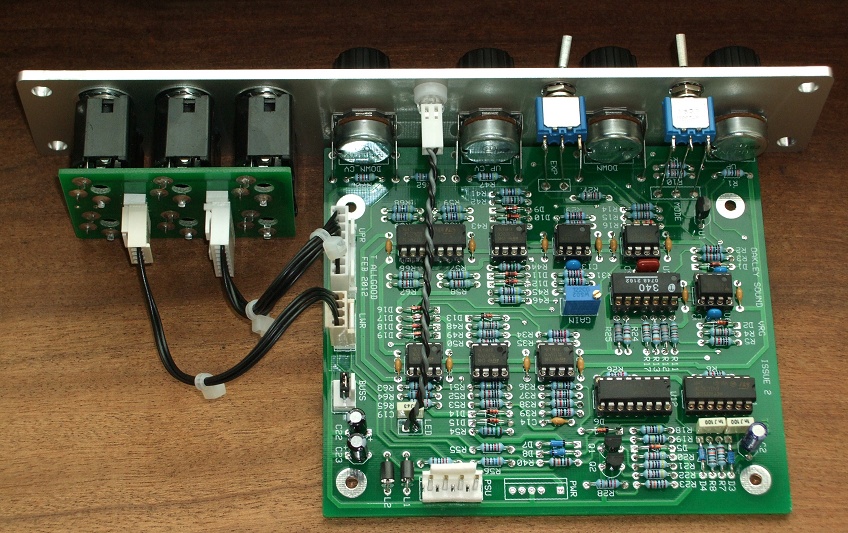
The issue 2 Oakley VRG behind a natural
finish Scheaffer panel. Note the use of the Sock6 board to keep
the socket wiring nice and tidy.
The module
accommodates either our standard Oakley/MOTM power header or a
Synthesizers.com power header. The current consumption is +44mA
and -37mA.
The board size
is 109mm (deep) x 124mm (high). As with all Oakley projects both PCBs are double
sided with through plated holes, have tough solder mask both
sides, and have bold component legending for ease of construction.
Project Downloads
Construction
Guide Our handy guide to building
Oakley DIY projects
Parts
Guide Our handy guide to buying
parts for Oakley DIY projects.
Schematics are only available
to purchasers of the PCBs and will only be sent via e-mail when
the board(s) are shipped.
Front Panel database
A Schaeffer front panel can be made for
this module. The databases can be found by downloading the
following links:
5U format 1U wide VRG
module in traditional black
5U format 1U wide
VRG module in natural finish
To read these files you will need
a copy of ‘Frontplatten designer’ from Schaeffer. The program also features on-line ordering, so it’s
easy to buy your panels from Scheaffer.
The company are based in Berlin in Germany
and will send out panels to anywhere in the world. Delivery to
the UK normally takes around ten days. For North American users
you can also order your Schaeffer panels from Front
Panel Express.
Back home