
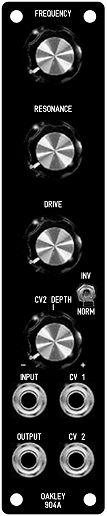
The suggested panel design for the Filter
Core 1U wide module.
The Oakley discrete ladder filter (DLF) is
my reworking of the classic 1960’s low pass filter module using
the circuits from the 904A filter and CP3 mixer and combining
them into one excellent sounding module. The module also features
a drive control which allows you to heavily overdrive the filter
circuit without producing a big change in output volume.
The audio signal pathway is almost all
discrete components with a dual IC op-amp only providing the
input and output signal processing for the drive control. Most of
the transistors will need to be hand matched in pairs for a Vbe
of +/-1mV. The frequency control circuitry is based around IC op-amp
much like my other filter designs and is temperature stabilised.
Prior to entering the filter circuit, the
audio signal passes through a clone of the CP3 mixer. This is
true even in the 1U wide version of the module which only has the
one input socket. The original CP3 module had two outputs, an
inverted output and a non inverted output. Apart from the change
in phase the two outputs sounded different when the input signal
was particularly loud. The Oakley DLF has a front panel switch to
select which of the input stage’s outputs go on to the filter
circuit. The DLF’s input stage will start to clip at around +/-4V,
but keeping the signal below this will ensure that the filter
receives a clean signal.
The discrete low pass filter circuitry is
also liable to distort when driven hard but does so in a less
aggressive manner than the mixer. The DLF’s drive control alters
the input signal level so the filter will operate from clean to
heavily overdriven. With variations in input level and drive
level it is possible to utilise the overdrive characteristics of
only the input stage, only the filter, or both for a really heavy
sound.
The filter will self oscillate at high
resonance. However, like the original module, the filter won’t
self oscillate below 100Hz. When the filter’s cut-off frequency
is swept at high resonance this limited resonance at low
frequencies gives the filter a powerful sound.
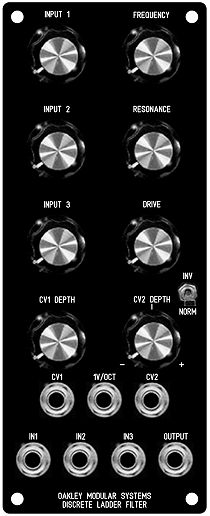
The suggested panel design for the 2U wide
module.
The 1U
‘Filter Core’ format is our way of handling filter modules.
Although the 1U module can be used as a filter module on its own,
it is expected that users will make use of external mixers to
control CV and audio levels going into the filter. In this way,
you will be able to have a collection of space saving 1U filter
cores that can be used with any generic mixer module. The popular
Oakley Multimix (for CV and audio) and/or the Fourmix (for just the audio) are the perfect choices for
such a mixer module.
For the 2U
design three audio inputs are provided, all of which have their
own attenuator. Three CVs can control the cut-off of the filter.
One is fixed at 1V/octave and the other two have an input
attenuator, one of which is a reversible attenuator.
The module accommodates either our standard
Oakley/MOTM power header or a Synthesizers.com power header.
Current consumption is approximately +80mA and -55mA.
The PCB is 89mm (deep) x 143mm (height).
As with all Oakley projects the PCB is double sided with through
plated holes, has tough solder mask both sides, and has bold
component legending for ease of construction.
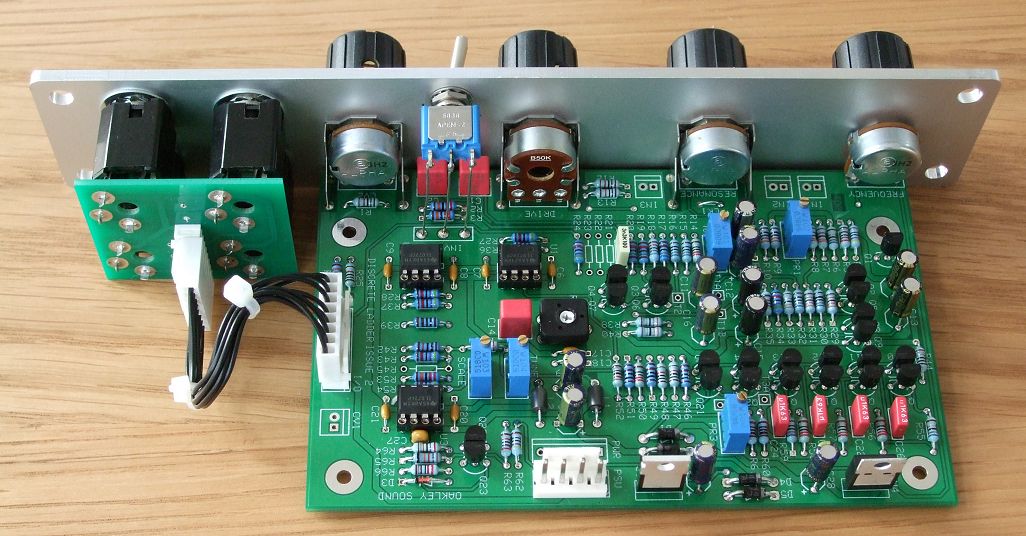
The issue 2 Oakley Discrete Ladder Filter
as a single width MOTM format module in a natural finish
Schaeffer panel. Note also the use of the optional Sock4 socket
board to help keep the wiring to the sockets neat and tidy.
Project Downloads
Discrete
Ladder Filter issue 2 User Manual
Discrete
Ladder Filter issue 2 Builder’s Guide
Construction
Guide Our handy guide to building
Oakley DIY projects
Parts
Guide Our handy guide to buying
parts for Oakley DIY projects.
Schematics are only available
to purchasers of the PCB(s) and will only be sent via e-mail when
the board(s) are shipped.
Use ‘save as…’ button to
download and view the files. IE users need to right hand mouse
click and then choose ‘save as’.
Front Panel database
A Schaeffer front panel can be made for
this module. The databases can be found by downloading the
following links:
5U format 1U wide (Filter
Core) module in traditional black
5U format 1U wide (Filter
Core) module in natural silver
5U format 2U wide (Full
Version) module in traditional black
To read these files you will need
a copy of ‘Frontplatten designer’ from Schaeffer. The program also features on-line ordering, so its
now even easier to buy your panels from Scheaffer.
The company are based in Berlin in Germany
and will send out panels to anywhere in the world. Delivery to
the UK normally takes around ten days. For North American users
you can also order your Schaeffer panels from Front
Panel Express.
Back home