
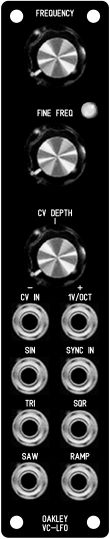
The suggested layout of the VC-LFO module
in a 1U wide panel.
This is a versatile yet easy
to use voltage controlled low frequency oscillator module that
can also be used as an audio VCO over a useful range.
The unit features sinusoid,
sawtooth, ramp, triangle and square outputs. All are available
simultaneously. A sync input is available to reset the waveforms
to a fixed point.
The module features two CV
inputs. One is fixed at 1V/octave. The other CV input is
controlled by a single pot on the front panel. When the pot is
turned right of its central position, the pot acts as a normal
attenuator; increasing the sensitivity of the CV input to a
maximum of 0.5V/octave. Left of centre, the pot will act in
inverting mode. Fully anti-clockwise the input will respond to -0.5V/octave.
A tricolour LED indicates the
output status.
For DIY builders of this
module it is possible to purchase the Sock8 circuit board which
is available separately. This little board speeds up the wiring
of the eight 1/4″ sockets and reduces the chances of any
wiring errors.
Power (+/-15V) is provided to
the board either by our standard Oakley 4-way header or
Synthesizers.com header. Current consumption is approximately 40mA
per rail.
The board size is 104 mm (high)
x 104mm (deep).
Specifications
The VC-LFO has an operating
range of lower than 0.002Hz (one cycle every eight minutes) to
over 14kHz from the front panel controls. The range can be
extended with external CV inputs. The maximum frequency of the VC-LFO
is well over 25kHz.
Range of Frequency control: 17
octaves
eg. When the fine control is
central the frequency pot can vary the output from 0.016Hz (one
cycle per minute) to 1.7kHz.
Range of Fine Frequency
control: 6 octaves
eg. When the main frequency
pot is central, the fine control will vary the rate from 1Hz to
64Hz.
These frequencies can be
altered over a limited range by the onboard trimmer, or more
significantly by a change in the master timing capacitor.
When used as an audio rate VCO
the usable range that conforms to 1V/octave (to +/-2cents) is
over six octaves from approximately 32Hz to 2kHz. This is none
too shabby for a low frequency oscillator. For accurate musical
use over 2kHz we recommend that you use the Oakley VCO.
Sync input requires a fast
rising gate exceeding 4V when active, or at least 2V peak pulse
or sawtooth waveform.
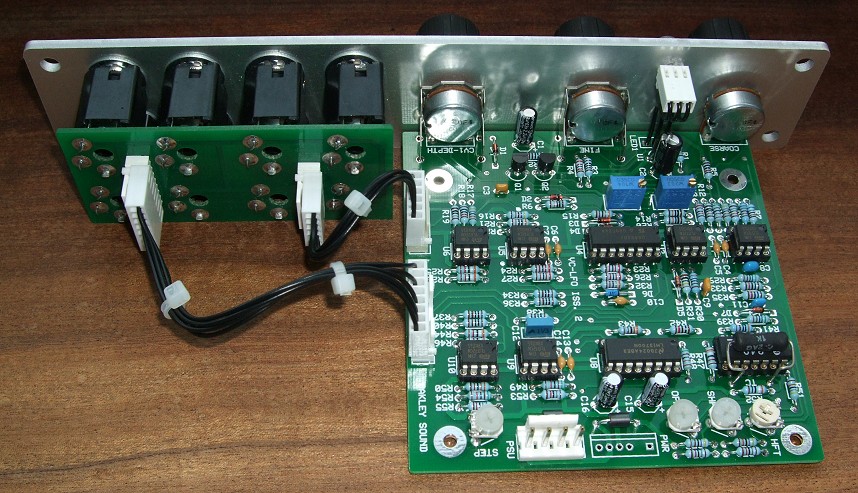
An earlier issue Oakley VC-LFO board behind
a natural finish Schaeffer panel. Issue 3.1 boards are similar.
Note the use of the optional Sock-8 board to make wiring the
socket field much easier.
Sound Samples
The following were made using
the VC-LFO as an audio oscillator. Pitch was being controlled via
the module’s 1V/octave input.
Simple sequence being played while
listening, in order, to the raw outputs of the saw, triangle,
square and sine.
The same simple sequence being played using
the sawtooth output but through a Superladder filter and a bit of
effects to add ambience.
Sync sweep samples. Using the sawtooth
output and syncing the VC-LFO with another VCO. The first set use
an ADSR to sweep the VC-LFO’s pitch, whilst the single note is
manually swept with the coarse frequency pot.
Some more sync sample hits. This time using
the other waveform outputs; square and then triangle.
The following sample set was
obtained using the Oakley ring modulator using the VC-LFO as the
modulator (Y-input). The first of the three sounds uses a stable
sine output from an Oakley VCO as carrier whilst the VC-LFO’s
frequency is manually swept with the frequency pot – this shows
the huge range of the frequency pot. The second sample processes
the output of two mixed saw VCOs and sweeps the frequency of the
VC-LFO from high to low. The final sample uses the same two saw
VCOs but triggers the VC-LFO with the gate thus each new note
always fades up from nothing.
Project Downloads
Please note: Earlier issue 3
boards are erroneously marked as issue 2. If you have a place for
an HFT trimmer on your board then it is an issue 3 board.
Construction
Guide Our handy guide to building
Oakley DIY projects
Parts
Guide Our handy guide to buying
parts for Oakley DIY projects
Links to schematics are
available to purchasers of the PCB or module and will be sent via
e-mail when the board(s) are shipped.
Front Panel database
A Schaeffer front panel can be made for
this module. The databases can be found by downloading the
following links:
5U format in
traditional black
To read these files you will need
a copy of ‘Frontplatten designer’ from Schaeffer. The program also features on-line ordering, so its
now even easier to buy your panels from Scheaffer.