
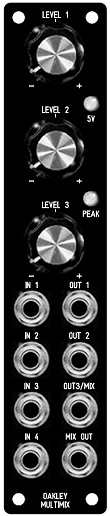
The suggested panel design for the MOTM
format Multimix.
A highly useful utility module. It’s a four
channel mixer with a twist. The first three inputs have each an
independant level control. Each level control can be set so that
the gain of the input is anything from -1.1 to +1.1. This means
that not only can inputs be added together, but can subtract as
well. With each input knob set to its middle position, then none
or very little of the input signal will reach the output.
Mixers with reversible attenuators on their
inputs are very useful for controlling audio and CVs. One
excellent application uses a MultiMix with a VCA to create a very
flexible ring modulator.
The Multimix also features a fourth input.
Whatever signal is connected here is summed with the final mixed
output. This can be used to cascade several Multimixes together
to form much larger mixers.
The module features a clever combination of
four output sockets to achieve a variety of uses. Two mix outputs
are available: One is MIX OUT and this is simply the four inputs
added together – the first three inputs being added according to
the levels set by the pots. The second main output is OUT3/MIX.
This is exactly the same as MIX OUT until you start connecting
jack plugs to either OUT1 and/or OUT2.
Inserting a jack into OUT1 and the IN1
signal will be removed from the OUT3/MIX socket. It will, however,
still be present at the MIX OUT socket. The OUT1 socket gives you
only that pot controlled version of the signal going into IN1. As
before the pot will control the level and phase of the signal.
You can thus use this pot to attenuate, or invert, CV or audio
signals independantly of what is happening on the other three
inputs. Inputs 2 and 3 also behave likewise. They can be treated
as independant reversible attenuator channels or be treated as
level controls on a mixer. It all depends on how those output
sockets are used.
The module also features two output level
LEDs. These monitor the signal level at the MIX OUT socket. The 5V
one lights when the signal exceeds +/-5V. The peak one lights
when the output signal is getting near clipping, ie. around +/-11V.
Special circuitry is employed to ensure the LEDs do not cause
power supply clicks when they turn on or off.
The input level pots can also be easily
configured as ordinary level pots rather than reversible
attenuators if desired.
Power (+/-15V) is provided to the board
either by our standard Oakley/MOTM 4-way header or Synthesizers.com
header. Current consumption is approximately 35mA per rail.
The Multimix issue 6 PCB size is 104mm (high)
x 104mm (deep).
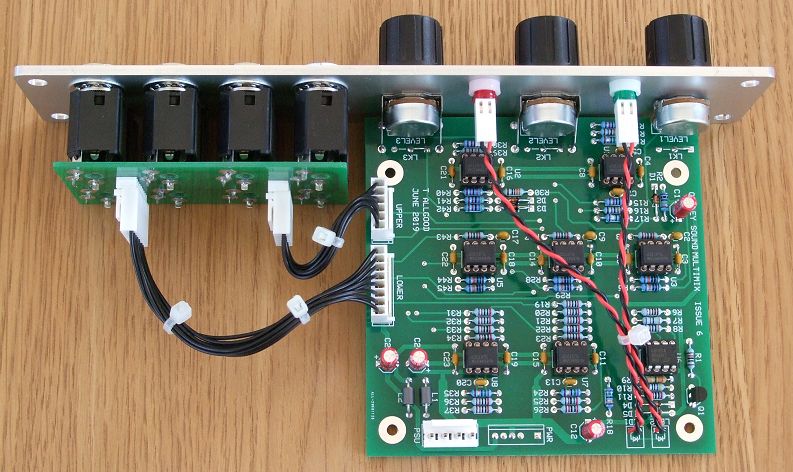
The Oakley Multimix issue 6 board behind a
natural finish Schaeffer panel. Note the use of the optional Sock-8
board to make wiring the socket field much easier.
Project Downloads
Multimix issue 6 Builder’s Guide
Multimix
issue 5 Builder’s Guide
Construction
Guide Our handy guide to building
Oakley DIY projects
Parts
Guide Our handy guide to buying
parts for Oakley DIY projects
Links to schematics are
available to purchasers of the PCB or module and will be sent via
e-mail when the board(s) are shipped.
Front Panel database
A Schaeffer front panel can be made for
this module. The databases can be found by downloading the
following links:
5U format filter
core module in traditional black
5U format filter
core module in natural silver
To read, edit and print this file
you will need a copy of ‘Frontplatten Designer’ from Schaeffer. Panels can be ordered via Schaeffer’s website.
Schaeffer are based in Berlin, Germany and
can send panels to anywhere in the world. Delivery to the UK
normally takes around ten days. For North American users you can
order your Schaeffer panels from Front
Panel Express.
Back home