
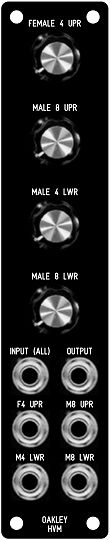
The suggested panel design for the single
width 1U wide MOTM format module.
The Oakley Sound HVM is an all analogue
audio signal modification device that replicates some of the
sounds made from a classic electronic keyboard first seen and
heard in 1979. The VP-330 is often thought of as a string
synthesiser and vocoder but some of the most ethereal sounds
utilise its four human voice tabs. Tabs are simply switches that
engage certain sounds – the terminology comes from organs and
they could be considered a bit like a preset in today’s keyboards.
The human voice sounds in the VP-330 were
created by using seven fixed frequency band pass filters – each
of the four tabs using differing mixes of the seven filters and
different octaves from the keyboard’s oscillators. They are not
particularly realistic when compared to vocal samples and other
techniques used in later instruments but they are very
interesting and sound great.
The HVM is different to standard fixed
filter banks (FFB) which have usually one input and one output.
FFBs typically allow the user to adjust the level from each
filter and the resultant outputs mixed together. In the HVM the
outputs of each of the seven filters are all equally summed to
one output socket. There are four inputs and each input socket
has a dedicated front panel control to adjust the level of the
signal that goes in to the filter bank. Each of the four signals
are sent to the seven filters with each input being sent to the
filters in different proportions. The differing proportions
correspond to the four tabs on the original instrument. It is
possible therefore to use up to four sources, for example four
VCOs at different octaves, and have them all mixed at varying
levels to create one output.
The original instrument’s four tabs were
divided into two for the upper section of the keyboard and two
for the lower section. The 4′ and 8′ refer to footages, another
organ term, 4′ being one octave above 8′. If you wish to be
faithful to the original instrument then you should use two VCOs,
spaced an octave apart, with the high VCO being fed into either
the 4′ Upper and the low VCO into the 8′ Upper, or with the high
VCO being fed into the 4′ Lower and the low VCO into the 8′ Lower.
Any type of signal can be used either single notes or, if you
have the polyphony, full chords can be processed. It is best to
have a harmonically rich waveform, such as a sawtooth or
squarewave, to give the filters something to work with.
The fifth input, INPUT (ALL), will send a
single audio input to all four inputs if no other input sockets
have jacks inserted. This allows a single audio source to drive
all four ‘tabs’ simultaneously. Inserting a patch lead into any
of the four main inputs will override any signal from the ALL
socket for that particular input.
The module accommodates either our standard
Oakley/MOTM power header or a Synthesizers.com power header. The
supply voltage is +/-15V and current consumption is around +/-45mA
The PCB is 109mm (deep) x 124mm (height).
The PCB is a four layer design, has tough solder mask both sides,
and has bold component legending for ease of construction. No
additional mounting holes are provided on this PCB. The PCB is
secured to the front panel by three pot brackets.
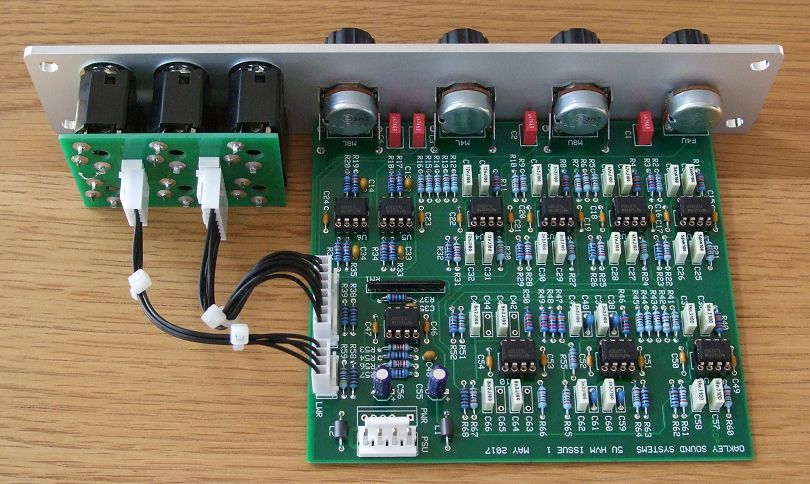
The Oakley HVM as a single width MOTM
format module in a natural finish Schaeffer panel. Note also the
use of our optional Sock6 socket board to help keep the wiring to
the sockets neat and tidy.
Sound Samples
Just noodling with a single
sawtooth VCO going into an Oakley HVM. The added vibrato is under
aftertouch control. Reverb added courtesy of Valhalla Vintage
Verb.
Simple single sawtooth input
from one Oakley VCO with notes played across the keyboard. Four
sets played with M8 LWR first, followed by M4 LWR (Option B),
followed M8 UPR and finally F4 UPR.
Project Downloads
Construction
Guide Our handy guide to building
Oakley DIY projects
Parts
Guide Our handy guide to buying
parts for Oakley DIY projects.
Schematics are only available
to purchasers of the PCB and will be sent via e-mail when the
board(s) are shipped.
Front Panel database
A Schaeffer front panel can be made for
this module. The databases can be found by downloading the
following links:
5U format 1U wide
module in traditional black
5U format 1U wide
module in natural (silver) finish
To read these files you will need
a copy of ‘Frontplatten designer’ from Schaeffer. The program also features on-line ordering, so its
now even easier to buy your panels from Scheaffer.
The company are based in Berlin in Germany
and will send out panels to anywhere in the world. Delivery to
the UK normally takes around ten days. For North American users
you can also order your Schaeffer panels from Front
Panel Express.
Back to projects page: Projects
Back Home: Oakley Sound