
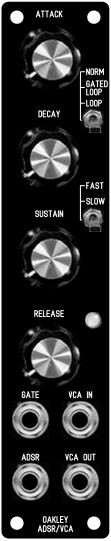
This is a very popular dual purpose module.
Not only does it feature a looping four stage envelope generator,
but it also has a high quality VCA onboard.
Two outputs are provided, one, labelled
ADSR, is the raw output of the core ADSR generator. The other,
VCA OUT, is the output of the integral VCA. This highly useful
circuit implementation hardwires the ADSR generator to the
control input of the VCA. The signal at the VCA’s signal input,
the VCA IN socket, will then be multiplied by the ADSR waveform.
You can use any signal into this input, audio or CV. If you use
CV, then the ADSR output level will be governed by the level of
the CV. If you use audio, then the ADSR waveform will control the
volume of that audio signal.
A typical use would have the IN socket
being driven by the velocity CV from a midi-CV convertor. Thus
the harder you hit the keys, the greater the ADSR output level.
If you use this to control a filter sweep, this can create
brilliantly effective touch sensitivity to your patch.
The circuit is configured so that if
nothing is plugged into the IN socket, the VCA OUT will behave
the same as the raw ADSR output.
The ADSR is operated by a gate signal, but
can also be triggered by slow rising CVs too due to the built in
schmitt trigger function. No additional ‘trig’ input is required.
The ADSR/VCA module is built on one PCB
called the VC-ADSR board. Although the 1U panel design does not
imply a voltage controlled design, the internal electronics are
all voltage controllable. This allows blisteringly fast minimum
attack and decay times. And yet, the controls with their true
exponential response, allow you to accurately adjust faster times
with ease.
Also on this module is an LED. This gives a
visual indication of the output level of the internal ADSR
waveform.
The module accommodates either our standard
Oakley/MOTM power header or a Synthesizers.com power header.
Current draw is around 35mA. The four layer printed circuit board
(PCB) is 143 mm (high) x 81 mm (deep).
For DIY builders of this module it is
possible to purchase the Sock4 circuit board which is available
separately. The little Sock4 board speeds up the wiring of the
four 1/4″ sockets and reduces the chances of any wiring
errors.
Loop Modes
The Oakley ADSR/VCA incorporates a looping
mode. Looping means that the output will rise to the attack peak
at the speed determined by the attack pot and then fall to 0.5V
at the speed determined by the Decay pot. It will then rise again
to the attack peak and then fall back to 0.5V and so on.
NORM – the module behaves as a standard
ADSR.
GATED – the output will loop only when gate
is high. As soon as gate arrives the output will rise up at the
attack speed and then decay at the decay time and repeat. If the
gate is removed at any point the output will then fall at the
release time.
LOOP – The module’s output will loop
continuously in AD mode. The Gate input has no effect in Loop
mode.
In both looping modes the position of the
sustain pot can be used to turn the looping on or off. At values
above 10% the looping will stop. This is very useful in the 2U
version of the module where the looping can be controlled by an
external CV.
Upgradable Design
This module can be upgraded to full voltage
control with an addition of an extra module that uses the ‘ADSR
Upgrade’ PCB. This board takes up a single width of panel space,
and is fitted next to the ADSR/VCA module to be controlled. The
upgrade can be added on at any time and installation is very
simple. Two small interconnects behind the front panels allow the
two boards to ‘talk’ to each other. See the VC-ADSR page for more details of the upgrade and the 2U VC-ADSR/VCA
module.
Specifications:
Attack times: 0.2 milliseconds to 32
seconds (fast) or 1.6 ms to 250 seconds (slow). Charging voltage
+10V, internal attack peak +5V. Pseudo linear ramp.
Decay/Release times: 0.38 ms to 50 s (fast)
or 3 ms to 400 seconds (slow). Time measured from 90% of sustain
value to 10% of sustain value. Exponential decay slope.
Sustain levels: 0 to 100%
The attack peak and maximum sustain level
is 5V from the ADSR socket.
With no jack plug inserted into the IN
socket, the attack peak and maximum sustain level is 5V from the
VCA OUT socket.
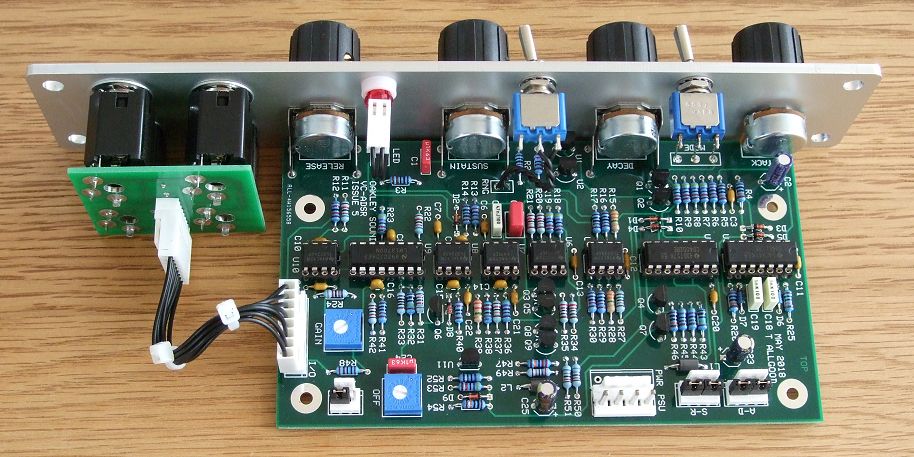
The four layer issue 5 VC-ADSR PCB behind a
natural finish Scheaffer panel and fitted with optional Sock4
board. Note also the two four way headers that can be attached to
the optional ‘ADSR Upgrade’ module to allow for full voltage
control over A, D, S and R parameters.
Project Downloads
Builder’s Guide for the issue 5 PCB
Construction
Guide Our handy guide to building
Oakley DIY projects
Parts
Guide Our handy guide to buying
parts for Oakley DIY projects
Schematics are only available
to purchasers of the PCB(s) and will only be sent via e-mail when
the board(s) are shipped.
Builder’s
Guide for the older issue 3 & 4 PCBs
Front Panel database
A Schaeffer front panel can be made for
this module. The databases can be found by downloading the
following links:
5U format in
traditional black
5U format (original
symmetrical design) in traditional black
To read, edit and print these
files you will need a copy of ‘Frontplatten Designer’ from Schaeffer. Panels can be ordered via the program using its
secure online ordering system.
Schaeffer are based in Berlin, Germany and
can send panels to anywhere in the world. Delivery to the UK
normally takes around ten days. For North American users you can
also order your Schaeffer panels from Front
Panel Express.
Back Home: Oakley Sound