
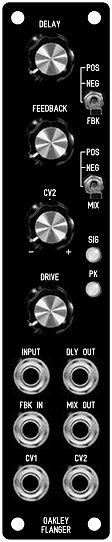
The Oakley
Flanger & Chorus module is an analogue delay line capable of
delaying audio signals from 0.5mS to 15mS. In conjunction with an
external LFO module this unit can be used to produce real time
vibrato, chorus and flanging effects. With the feedback control
set to maximum the module can be set to self-oscillate
The delayed
audio output is available from the DLY OUT socket. While the MIX
OUT socket has a equal mix of input signal and delayed signal.
The phase of the delayed signal that is mixed may be selected to
be inverted (NEG) or non-inverted (POS) by the use of the MIX
switch. This is particularly useful when used for chorus or
flanging as the two modes can create completely different effects.
A feedback path
from the delayed output back to the input is available and you
have control over both the amount, via the FEEDBACK pot, and
phase of the signal, via the FBK switch. Inserting a jack plug
into the FBK IN socket will break the internal feedback path and
allow another signal to be sent into the delay line. This could
allow additional processing of the raw delayed signal, from the
DLY OUT socket, prior to being sent back into the delay line
again. For example, using a VCA to process the feedback signal
would allow CV control of the feedback level.
There are two
control voltage (CV) inputs. CV1 has a fixed sensitivity while CV2
has its own sensitivity control. CV2’s control pot is a
reversible attenuator, so you are able to adjust not only the
depth of the modulation but also the polarity. Although not
specifically designed to track to 1V/octave, using the CV1 input,
the module can be used as tuned delay line over a useful
proportion of the full operating range.
The delay line
itself is based around two 3207 bucket brigade delay (BBD)
devices controlled by a voltage controlled oscillator (VCO)
running from around 33kHz to over 1MHz. Audio bandwidth of the
delayed signal extends to 14kHz and several unusual design
features ensure that the module is relatively quiet compared to
other units of its type.
Two LEDs provide
visual indication of the signal level being sent to the BBD
devices. The DRIVE control should be adjusted to ensure that the
green LED remains lit for optimum signal level. The red LED will
light when the signal level is close to, or is, being overdriven.
The module will not be harmed when the signal is overdriven and
there is a soft clipping circuit in place to ensure the
overdriven sound is musically useful. The DRIVE control allows a
variety of different signal levels to be used with the module
although the expected signal level would be expected to be
between 0.5V(peak) and 8V(peak).
The printed
circuit board (PCB) uses a mixture of through hole and surface
mount components. The op-amps, non-polar capacitors, resistors
and small diodes are all surface mount. The op-amps are SO8
packages, capacitors and resistors 0805 and diodes SOD323. Most
builders should find these no problem to solder even if they have
not assembled modules with surface mount devices before. To
calibrate the unit an oscilloscope is useful but not essential.
The module accommodates either our standard
Oakley/MOTM power header or a Synthesizers.com power header. The
supply voltage is +/-15V and current consumption is around +75mA
and -45mA.
The PCB is 109mm (deep) x 124mm (height).
The PCB is a four layer design, has tough solder mask both sides,
and has bold component legending for ease of construction.
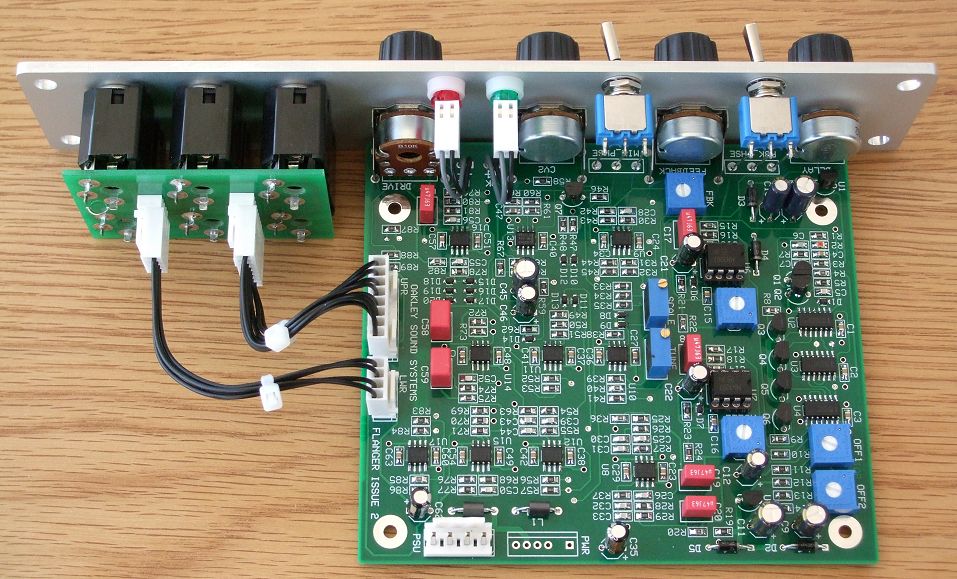
The Oakley Flanger as a single width MOTM
format module in a natural finish Schaeffer panel. Note also the
use of our optional Sock6 socket board to help keep the wiring to
the sockets neat and tidy.
Sound Samples
Quick track recorded using an
Oakley modular to showcase the Oakley Flanger/Chorus module. Lead
line is one VCO passed through a DLF filter, Discrete VCA and
onto the Flanger/Chorus. Bass in the second half is the same
patch but this time the filter is being swept with a VRG and the
flanger module is used to create a deep chorus sound. Some reverb
used on the leadline and plucked bell sound.
Nord Lead A1 string machine patch being
processed through the Oakley Flanger/Chorus. Slow triangle wave
LFO and with the Flanger/Chorus module set to relatively high
positive feedback. Some light reverb has been added.
Nord Lead A1 string machine patch being
processed through the Oakley Flanger/Chorus. Slow triangle wave
LFO and with the Flanger/Chorus module set to relatively high
negative feedback. Some light reverb has been added.
Simple traditional VCO-VCF-VCA patch. First
part is completely dry, and then other parts sent into the
Flanger/Chorus module. Settings changed manually as the same
simple sequence goes round and round. Second and third show the
chorus sound. Fourth bit decreases the delay time to give the
classic flanging – increasing the feedback creates a deep flanger
sound. Fifth bit is another flanger but uses negative feedback.
Sixth part is manually altering the controls for excessive
effects, firstly with positive feedback and then negative
feedback.
Standard VCO-VCF-VCA patch using the
flanger module to shift the pitch. Firstly you hear the pitch
being bent by an EG triggered from the gate on a simple riff,
then a filtered constant pitch sawtooth being pitch shifted by a
LFO – firstly subtle and then more extreme. The final samples in
this collection are filtered white noise being flanged. The delay
time and feedback controls are being manually altered. The first
part you hear is positive feedback and the second is negative
feedback.
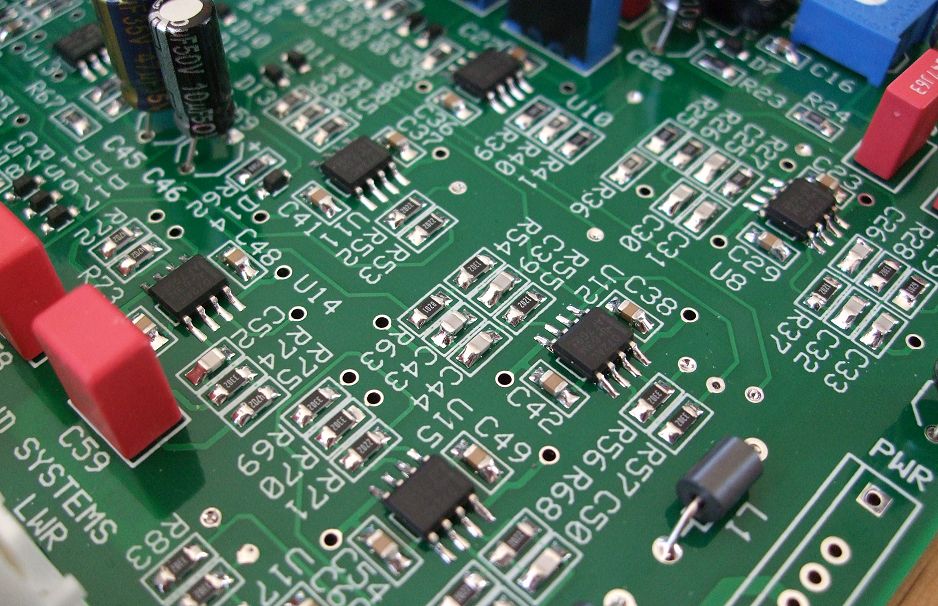
The PCB is populated with both surface
mount devices (0805 resistors and capacitors, SOD323 diodes &
small outline ICs) and standard through hole components.
Project Downloads
Flanger/Chorus
Builder’s Guide
Construction
Guide Our handy guide to building
Oakley DIY projects
Parts
Guide Our handy guide to buying
parts for Oakley DIY projects.
Schematics are only available
to purchasers of the PCB and will be sent via e-mail when the
board(s) are shipped.
Front Panel database
A Schaeffer front panel can be made for
this module. The databases can be found by downloading the
following links:
5U format 1U wide module
in traditional black
5U format 1U wide
module in natural (silver) finish
To read these files you will need
a copy of ‘Frontplatten designer’ from Schaeffer. The program also features on-line ordering, so its
now even easier to buy your panels from Scheaffer.
The company are based in Berlin in Germany
and will send out panels to anywhere in the world. Delivery to
the UK normally takes around ten days. For North American users
you can also order your Schaeffer panels from Front
Panel Express.
Back Home: Oakley Sound