
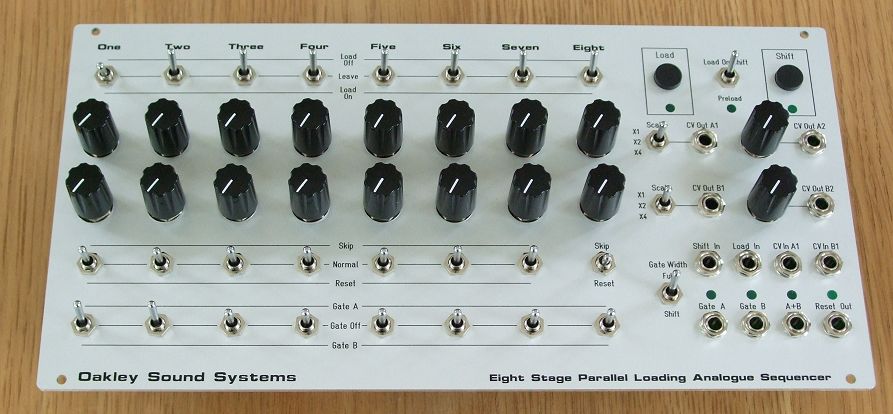
The Oakley Sound Sequencer is a 50HP
wide eurorack analogue sequencer with a maximum of eight steps
and multistage loading capability. Each step can be selected to
reset the sequence back to the start, or to skip and go straight
to the next step without being engaged. Through a set of switches
at the top of the module it is possible to load multiple stages
so that more than one step at a time can be made active. In this
way, the notes on each active step are added together to form a
new control voltage.
The Sequencer is designed to be played
as the sequence is running, new notes can be selected, steps can
be changed to skip or reset, and the number of active steps can
be altered on the fly. This hands on approach produces a real
time controllable musical instrument that can create constantly
changing sequences that belie the initial number of available
steps.
Each step on the sequencer has two
control voltage channels, A and B, each controlled by its own row
of pots. Each channel has two outputs. One output has a fixed
range determined by a three way toggle switch that can be set so
that a single active step can be varied from either 0 to 1V, 0 to
2V, or 0 to 4V. The second output is fully variable and can be
adjusted so that a single active step can be varied from 0V to a
maximum of 9.5V. If multiple steps are selected than the output
CV will increase linearly, so with two active steps producing 1V
each, the final output will be 2V.
A reset output (+5V when active) will go
high when the sequencer returns back to first active step. This
can be used to trigger other modules such as a sequential switch
which can allow both channels to be alternatively switched to
allow sequences of up to 16 steps long.
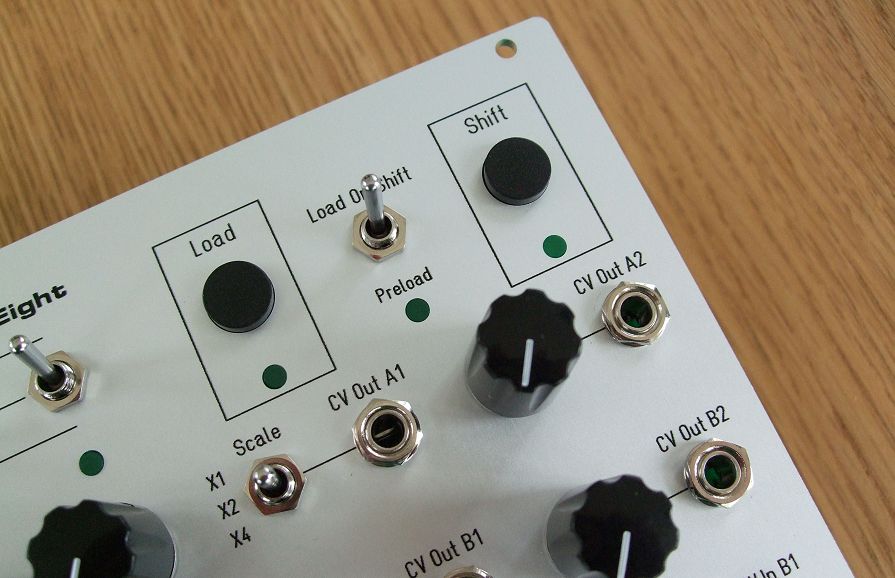
The sequencer is advanced by use of the
external shift input or the front panel’s shift button. The
external shift input can be any positive going signal above 1V.
The sequencer can be shifted at very high speeds, over 20kHz, so
it is possible to use the sequencer to generate audio waveforms
and divide down effects. Some other sequencers use the word ‘sync’
or ‘clock’ to designate the shift function. An LED lights up
whenever a shift command is active.
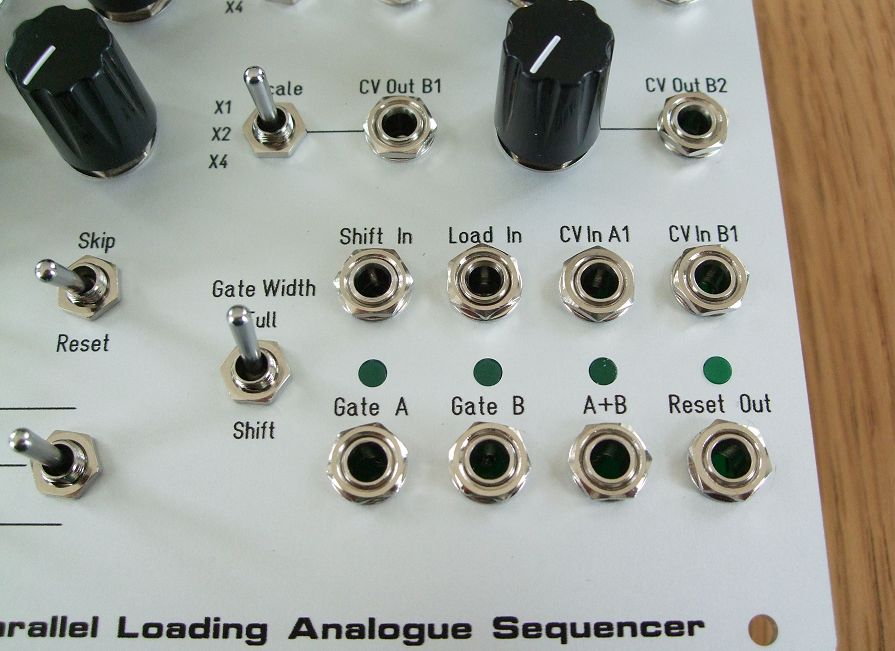
Each of the eight steps has a three way
gate switch. This selects whether any active steps control one of
two gate outputs. Each step can be set to trigger either Gate A,
Gate B or neither. A third gate output goes high when either Gate
A or Gate B is active. All gate outputs are +5V when active and 0V
when off. A toggle switch selects whether the gate outputs are
high whenever any selected step is active, or are only high when
both the selected step and the shift command is active.
Multiple steps can be selected by the
Oakley Sequencer’s load function. Like the shift command, load
can be instigated by either an external gate type signal or a
push button. At the top of each step is a three way switch. On a
load command, each switch can be set to force that stage to
either, be switched on, be switched off, or left in whatever
state it is already in. Traditional one step sequencing is simply
obtained by having all switches in the off state bar the first
one. Pressing load is then the equivalent of a simple reset.
Through the ‘load on shift’ switch the load command can either be
set to load the moment the load is activated, or to wait until
the next shift command is received. The latter is very useful for
keeping things in time with the master tempo clock. An LED lights
once the load is activated and is waiting for the next shift
command.
Current consumption is +85mA and -40mA
at +/-12V.
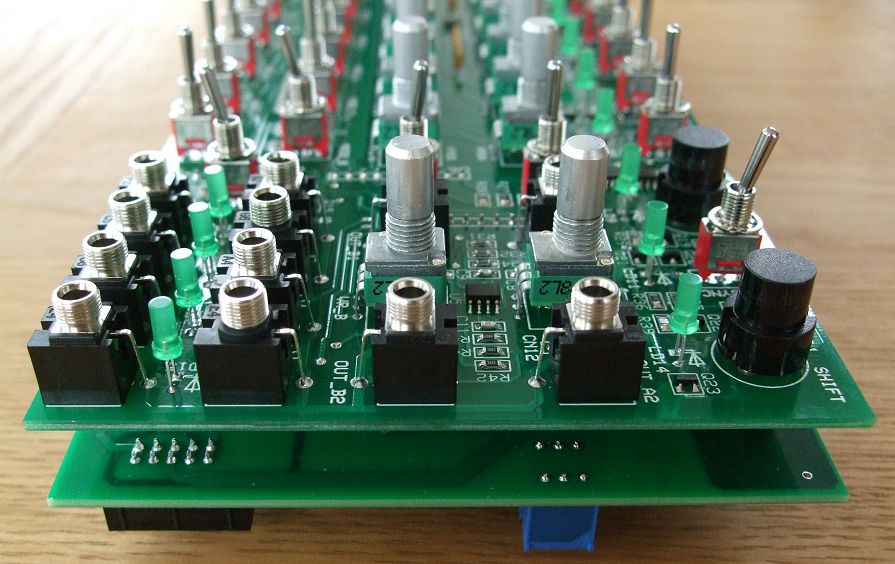
The PCB set
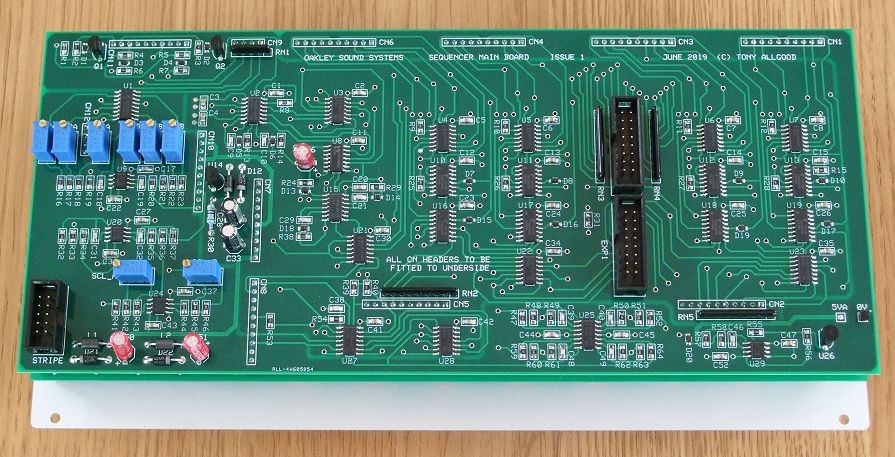
The sequencer comprises of two circuit
boards. The main board houses the digital circuitry, the power
supply and reference circuits, and the analogue output circuitry.
The pot and switch board has all the pots, switches and sockets
that are attached to the front panel, as well as the LED drivers,
the analogue pot drivers, and the CV summing circuitry. The main
board is a four layer design, while the pot and switch board is a
two layer design. Each board is the same size; 249 mm x 107 mm.
The majority of the components are
surface mount parts. The ICs are SOIC, the resistors and
capacitors are 0805, and the diodes are SOD123. All components
are standard parts and this is a hardware only project – there is
no firmware or microcontrollers to program.
Two 16 way IDC headers are provided on
the main board for further expansion. One header carries the
eight individual stage outputs, and the other has the eight set
and clear inputs for the individual stages.
Sound Samples
The Oakley Sequencer drives a DVCO
whose VCOs, one saw and one square an octave lower, feed an
Oakley COTA and then to the final VCA and out. The sequencer’s
second channel modulates the filter’s cut-off. The sequencer’s
parallel load function is played manually to create several
different sequences from the same eight notes. The COTA’s
settings and the envelope’s decay time are manually tweaked as
the set plays. A simple mono delay is added for that Berlin
School feel.
A simple eight step sequence
modulates both the pitch of the DVCO’s two oscillators and cut-off
frequency of an Oakley SVF. The second channel of the sequencer
and an Oakley Envelope modulates the filter’s cut off frequency.
The SVF’s pots and Envelope’s decay time is manually altered as
the sample progresses. Near the end of the sample one of the VCOs
is tuned up an octave and a bouncy delay is added.
Project Downloads
Construction
Guide Our handy guide to building
Oakley DIY projects
Parts
Guide Our handy guide to buying
parts for Oakley DIY projects
Schematics are available to
purchasers of the PCBs and will only be sent via e-mail when the
board(s) are shipped.
Front Panel database
A Schaeffer front panel can be made for
this module. The database can be found by downloading the
following link:
50HP Eurorack
format in natural silver
To read, edit and print this file
you will need a copy of ‘Frontplatten Designer’ from Schaeffer. Panels can be ordered via Schaeffer’s website.
Schaeffer are based in Berlin, Germany and
can send panels to anywhere in the world. Delivery to the UK
normally takes around ten days. For North American users you can
order your Schaeffer panels from Front
Panel Express.
Back to Eurorack projects page
Back Home: Oakley Sound