

The 8HP wide Oakley Sound
Human Voice Module (HVM) is an all analogue audio signal
modification unit that replicates some of the sounds made from a
classic electronic keyboard first seen and heard in 1979. The VP-330
is often thought of as a string synthesiser and vocoder but some
of its most ethereal sounds utilise its four human voice settings.
The human voice sounds of
the VP-330 were created by using seven fixed frequency band pass
filters – each of its four preset voices using differing mixes of
the seven filters and different octaves from the keyboard’s
oscillators.
The HVM recreates these
filter sections and arranges them in a flexible fixed filter bank
format. All seven filters are presented with the same input
signal, its level controlled by a single pot, Level. The output
of each filter is sent to its own level pot and then mixed with
the other six filter outputs to make one single output. Each
filter section consists of two narrow band pass filters of
slightly differing frequencies in series. The operating
frequencies are 220Hz, 330Hz, 600Hz, 910Hz, 1300Hz, 2800Hz and
3300Hz.
Any type of signal can be
processed either single notes or, if you have the polyphony, full
chords can be used. It is best to use an harmonically rich
waveform, such as a sawtooth or square wave, to give the filters
something to work with.
The original design used
seven bandpass filters with the lowest two bands having very
similar operating frequencies, 185Hz and 220Hz. In the suggested
build of the HVM I have made them further apart, 220Hz and 330Hz,
extending the usefulness of the module. However, an alternative
build is possible that recreates the original behaviour if needed.
Current consumption is +/-40mA
at +/-12V.
Sound Samples
Just noodling with a single
sawtooth VCO going into an Oakley HVM. The added vibrato is under
aftertouch control. Reverb added courtesy of Valhalla Vintage
Verb.
A polyphonic set. This is the
Nord Lead A1 played through the HVM while the HVM’s settings are
wiggled manually. The A1 is used to generate a single sawtooth
waveform and using delayed vibrato as well as the A1’s internal
chorus setting.
The PCB Set
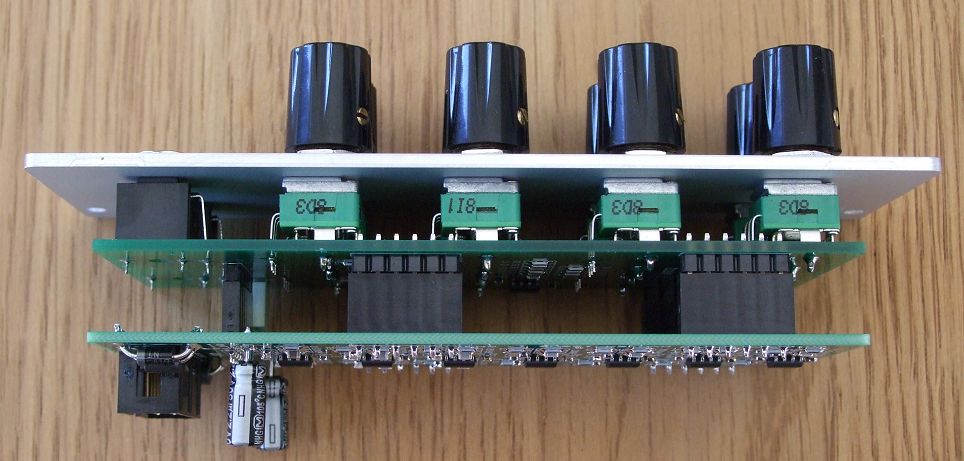
The HVM comprises of two
printed circuit boards (PCBs) connected together with five 0.1
(2.54mm) single in line (SIL) headers and sockets. The main board
on the rear of the module houses the seven filters and the power
supply inlet. The pot board has the pots and sockets that are
attached to the front panel, as well as the input and output
circuitry. The main board is a four layer design, while the pot
board is a two layer design. Each board is the same size; 40 mm x
107 mm.
The
majority of the components are surface mount parts. The ICs are
SOIC, while the resistors and capacitors are 0805. All components
are standard parts.
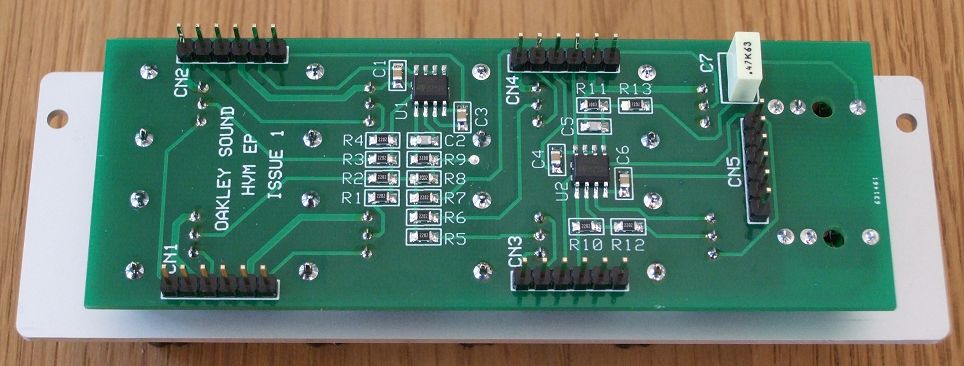
One side of the Pot Board
showing the input and output circuitry. The pots and sockets are
mounted on the other side of the board. The SIL headers connect
to the HVM’s main board which simply fits on top.
Project Downloads
Construction
Guide Our handy guide to building
Oakley DIY projects
Parts
Guide Our handy guide to buying
parts for Oakley DIY projects
Schematics are available to
purchasers of the PCBs and will only be sent via e-mail when the
board(s) are shipped.
Front Panel database
A Schaeffer front panel can be made for
this module. The databases can be found by downloading the
following links:
8HP panel with 220Hz
as the lowest frequency
8HP panel with 185Hz
as the lowest frequency
To read, edit and print this file
you will need a copy of ‘Frontplatten Designer’ from Schaeffer. Panels can be ordered via Schaeffer’s website.
Schaeffer are based in Berlin, Germany and
can send panels to anywhere in the world. Delivery to the UK
normally takes around ten days. For North American users you can
order your Schaeffer panels from Front
Panel Express.
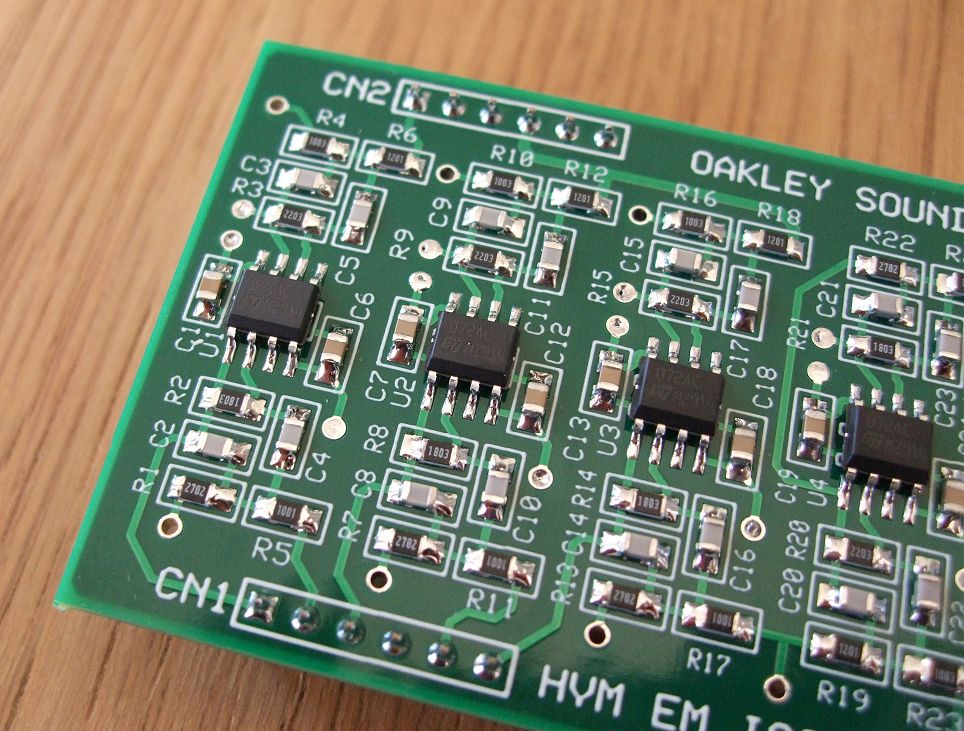
A
close up of four of the seven filter sections on the HVM’s main
board. Each filter section comprises of two Deliyannis resonators
in series.
Back to Eurorack projects page
Back Home: Oakley Sound