
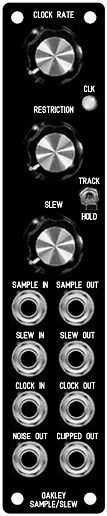
This compact single width module features a
powerful sample and hold module with controllable correlation, a
slew generator, a wide range clock oscillator and a dual output
noise generator. It can be used to generate random and pseudo
random control voltages, staircase waveforms, deliberate aliasing
of audio signals and many other uses.
The Oakley sample/slew module has two modes
of operation selected by a switch on the front panel.
The first is the ‘hold’ mode. This mode is
the traditional sample and hold (S/H). It has a signal input, a
signal output and a clock input. The module’s job is to memorise
the input voltage and present that to the output socket on
command of the rising edge of a clock signal. The clock signal is
any signal input you like, but it is traditional to use a gate
type pulse. If a signal is inserted into the clock input, when
the signal rises over 1V or so, the command is given to hold. The
hold output will then remain fixed no matter what the input
signal is now doing. That is until the command to hold is given
again whereby it attains a new output value.
The second mode is ‘track’. This functions
like the so-called ‘sample and hold’ module on the Korg MS-20.
With a clock input above 1V then the output of the module will
follow in the input signal. When the clock input falls below 1V
the output will then be held and not change again until the clock
input rises again above 1V.
The restriction pot affects the way the
hold output changes with respect to the current input level and
previously held output level. With the pot fully off the unit
behaves just like any other S/H, but at full, the output is
restricted to move by only a small amount after each new sample.
The output will still have the same range as the input, but will
need more hold commands to get there
In reality the hold function is not perfect
in either mode. The module uses an analogue memory module and as
such the stored voltage will slowly change over time. We
typically call this change’ droop’ because the voltage tends to
be drawn down to zero. The droop is relatively small and for most
synthesiser patches it is not a problem.
The module features an inbuilt clock
generator. This essentially is a wide range VCO (from about one
cycle per minute to over 2kHz) which can be used to directly
control the S/H module when no jack is inserted into the clock in
socket. The output of the oscillator is available as a +/-5V
square wave at the clock out socket.
The slew generator can be accessed
separately from the S/H section, but its input is normalised to
the output of the S/H when there is no jack plug inserted into
the slew input socket. The slew generator smooths any sudden
changes in the input signal. Thus a square wave becomes more like
a triangle, and keyboard CVs start sliding between notes.
A noise source is available from the noise
out socket. The noise could be described as white with a gentle
roll off above 6kHz. This analogue random voltage source can used
in conjunction with the S/H to produce the classic sample/hold
patterns heard in numerous recordings. The clipped out socket is
an alternative noise source. This features the same white noise
signal but soft clipped to +/-5V. This signal is less random as
the noise signal swings between defined levels, but it is ideal
when used with the S/H as it creates a more predictable output.
The CLK LED lights when the clock input is
above 1V.
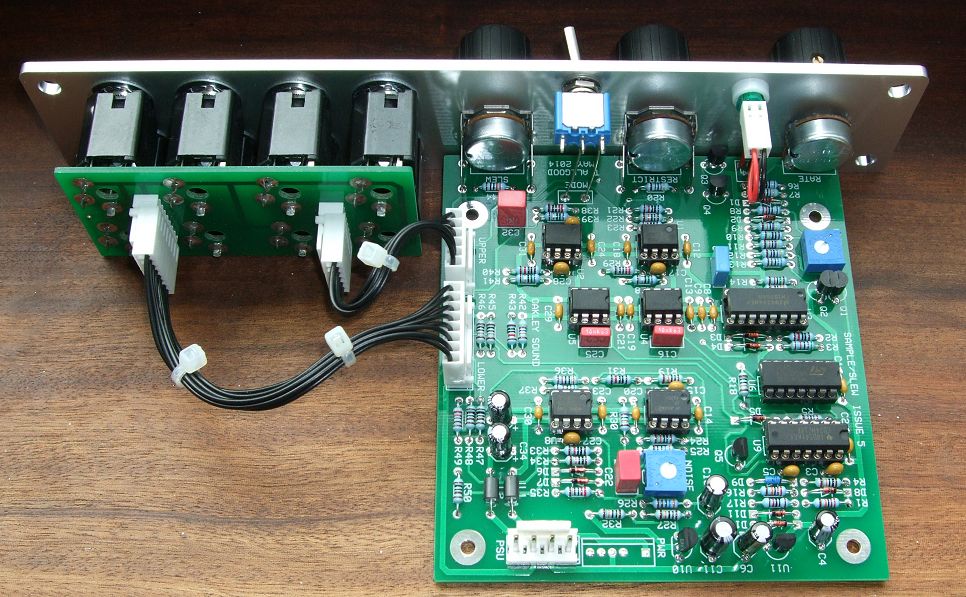
The 1U MOTM
version behind a natural finish Scheaffer panel. Note the use of
the optional Sock-8 board to make wiring the socket field much
easier.
The module
accommodates either our standard Oakley/MOTM power header or a
Synthesizers.com power header. The current consumption is +44mA
and -34mA.
The board size
is 112mm (deep) x 104mm (high). As with all Oakley projects the PCB is double sided
with through plated holes, has tough solder mask both sides, and
has bold component legending for ease of construction.
Project Downloads
Sample/Slew
issue 5 User Manual
Sample/Slew
issue 5 Builder’s Guide
Construction
Guide Our handy guide to building
Oakley DIY projects
Parts
Guide Our handy guide to buying
parts for Oakley DIY projects.
Schematics are only available
to purchasers of the PCBs and will only be sent via e-mail when
the board(s) are shipped.
Front Panel database
A Schaeffer front panel can be made for
this module. The databases can be found by downloading the
following links:
5U format 1U wide
Sample/Slew issue 5 module in traditional black
5U format 1U wide
Sample/Slew issue 5 module in natural finish
To read these files you will need
a copy of ‘Frontplatten designer’ from Schaeffer. The program also features on-line ordering, so it’s
easy to buy your panels from Scheaffer.
The company are based in Berlin in Germany
and will send out panels to anywhere in the world. Delivery to
the UK normally takes around ten days. For North American users
you can also order your Schaeffer panels from Front
Panel Express.
Back home