
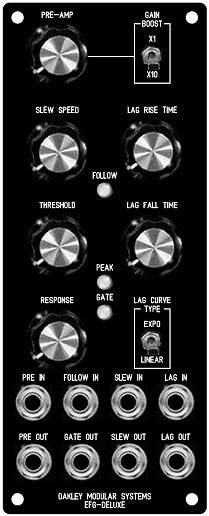
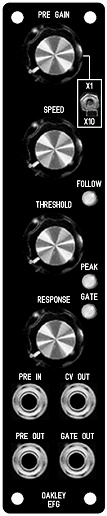
The double width EFG-Deluxe (left) and the
single width EFG (right) – both shown in the suggested standard
finish MOTM format.
An envelope follower takes an audio input
and converts it into a control voltage. This control voltage will
rise and fall with the overall volume of the input signal. The
louder the input, the bigger the output of envelope follower. The
Oakley issue 6 EFG has a fully variable speed CV output thanks to
its internal four stage slew generator. Set to fast the CV output
will respond very quickly to incoming audio and is therefore
suitable for tracking fast moving cymbal and hi-hat patterns. Set
it more slowly and it is more useful in processing overall audio
volume. By using the CV output to control VCAs and VCFs it is
very easy to create synchronised patterns that keep in perfect
time with a drum machine or other musical input.
Another feature of the Oakley EFG, is the
provision of a gate extractor. This part analyses the peaks in
the music and creates a gate type signal in time with these peaks.
This can be used to trigger envelope generators in time with an
external drum loop or click track. Two rotary controls, threshold
and response, enable you to get clean gate signals from all sorts
of input material.
The Oakley EFG now comes with a wide range
three stage input pre-amplifier. This allows guitars and other
unbalanced external instruments to be processed simply. You can
use this output for driving other modules.
The double width deluxe version of the
module utilises a built in lag or slew module. Unlike earlier
versions, issue 6 of the EFG main board contains all the
circuitry required. Builders of the EFG-Deluxe do not now need a
separate, and now defunct, Little-Lag PCB. If making the single
width standard EFG the parts pertaining to the Little-Lag circuit
are simply omitted.
And finally the EFG, in either guise, has
three LEDs. One showing input overload, one for gate status, and
one for a visual indication of the slewed CV output.
For DIY builders of this module it is
possible to purchase the Sock4 circuit board which is available
separately. This little board speeds up the wiring of the four 1/4″
sockets and reduces the chances of any wiring errors. Two Sock4
boards would be required to make an EFG-Deluxe.
Power (+/-15V) is provided to the board
either by our standard Oakley 4-way header or Synthesizers.com
header. The board size is 143 mm (high) x 107mm (deep). Current
draw is around +50mA and -40mA.
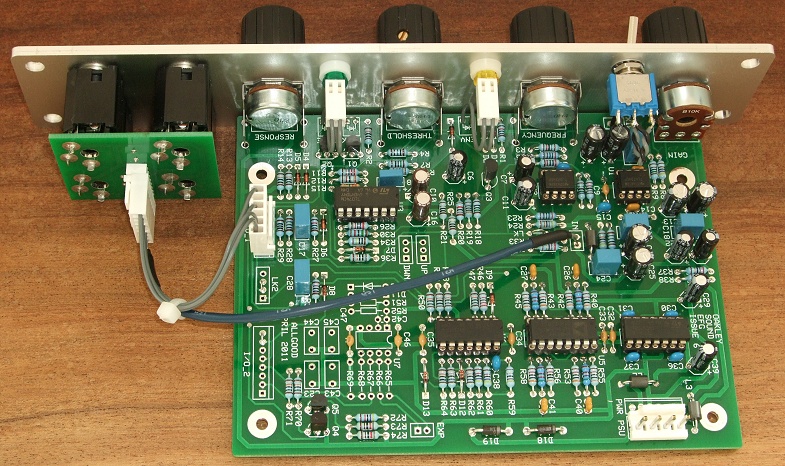
This is the prototype of the standard
single width EFG behind a natural finish Scheaffer panel. The
unpopulated section in the lower left hand corner of the board
belongs to the lag circuitry used on the double width EFG-Deluxe
module. Note the use of the optional Sock4 board to facilitate
wiring to the four sockets. The peak LED is not fitted to this
particular module but it would normally sit to the right of the
green ‘gate’ LED.
Project Downloads
Builder’s
Guide for EFG issue 6
Construction
Guide Our handy guide to building
Oakley DIY projects
Parts
Guide Our handy guide to buying
parts for Oakley DIY projects.
Links to schematics are
available to purchasers of the PCB or module and will be sent via
e-mail when the board(s) are shipped.
Front Panel database
A Schaeffer front panel can be made for
this module. The databases can be found by downloading the
following links:
5U format 1U wide (EFG
issue 6) module in traditional black
5U format 2U wide (EFG-Deluxe
issue 6) module in traditional black
To read these files you will need
a copy of ‘Frontplatten designer’ from Schaeffer. The program also features on-line ordering, so its
now even easier to buy your panels from Scheaffer.
The company are based in Berlin in Germany
and will send out panels to anywhere in the world. Delivery to
the UK normally takes around ten days. For North American users
you can also order your Schaeffer panels from Front
Panel Express.