
Overdrive-II: Analogue Overdrive, Distortion and Harmonic
Multiplier Module
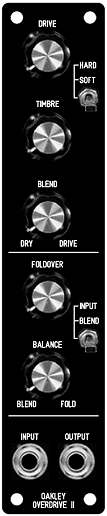
The Oakley Overdrive-II features two
different waveform modifiers to produce a wide range of
overdriven and distortion sounds.
The first waveform modifier is a classic
overdrive circuit which can produce a sound that is familiar to
many guitarists. The original issue Oakley Overdrive module
contained only this part. The circuit has two basic modes
selected by a switch. ‘Hard’ is a raucous distortion type effect
useful for grunging up your signal. ‘Soft’ is a more subtle
effect and produces a clean sounding overdriven amp sound.
Three front panel pots control the sound in
this section. Drive controls the overall gain of the circuits
‘pre-amplifier’ stage and essentially determines the level of
overdrive or distortion. Timbre is an effective tone control that
cuts or accentuates the additional harmonics produced by the pre-amplifier
stage. And the Blend pot is essentially a wet/dry mix control
that allows you to add only as much of the effect as you want.
The second waveform modifier is a harmonic
multiplier. This part of the module produces additional harmonics
by folding over the input signal so that the tops and bottoms of
the waveform are forced the wrong way. This produces strident
changes in tone that are dependant on the signal level. Up to two
stages of symmetrical folding are available and at the output
there is a soft clipping circuit to prevent excessive folding at
extreme input levels.
Two front panel pots affect the action of
this circuit. Foldover adjusts the gain of the harmonic
multiplier and controls the amount of folding the input signal
will be subjected to. The Balance control is another wet/dry
control so that you can mix the output of the overdrive circuit
with the harmonic multiplier.
The input/blend switch selects whether the
input to the harmonic multiplier comes directly from the input
socket or the overdrive circuit. Thus the two modifiers in this
module can be operated in series or in parallel. In conjunction
with the blend and balance pots you can create a wide variety of
different tones.
Voltage control is determined not within
this unit, but as part of the signal chain placed before this
module. Using a VCA
to control the signal level that is fed into
this unit will determine the strength of the overdrive,
distortion or folding. Using a VCF to alter the timbre of the
signal fed to this module will control the overall harmonic level
far more than using a filter alone. In fact, hard sync type
sounds can be easily obtained by simply sweeping the filter’s cut-off
frequency.
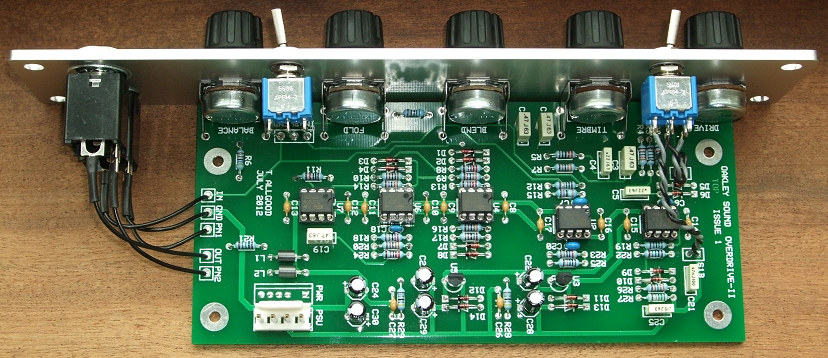
The module accommodates either our standard
Oakley/MOTM power header or a Synthesizers.com power header.
Current draw is approximately 25mA per rail.
The PCB is 66mm (deep) x 158mm (height).
The five pots are normally board mounted for speed and simplicity
As with all Oakley projects the
PCB is double sided with through plated holes, has tough solder
mask both sides, and has bold component legending for ease of
construction.
The Overdrive-II in a
natural finish MOTM format front panel.
Sound Samples
A single Oakley VCO on sawtooth driving a
TSL which in turn feeds the Overdrive-II module. The output of
the Overdrive is fed to the final ADSR/VCA and out to the DAW. A
simple 3/16th & 6/16th delay is applied to the sequence for
the Berlin School feel.
The track features a simple eight note
sequence. There are essentially four parts of more or less equal
length but recorded as one long piece. The first three parts
start with the dry sound coming out of the filter. The first part
is overdrive, the second is distortion, the third is the harmonic
multiplier on its own, and then the fourth part starts as the
harmonic multiplier is now driven from the overdrive section.
In each section I play with the various
controls on the Overdrive-II module and occasionally tweak the
filter’s cut-off and resonance controls a bit. It’s worth
downloading the file as the real time streaming sound quality is
not that great.
The next set of samples were
recorded using a small modular set up comprising of one VCO, one
COTA filter, one original Overdrive module, two ADSR/VCA and a
midiDAC to control them all.
The Oakley Overdrive module is connected to the -24dB/octave
output of the COTA VCF module and its output is fed to the ADSR/VCA
module for final volume shaping.
A lightly overdriven
solo sound using the COTA VCF to shape the harmonics heard
More overdrive with
the COTA set to highish resonance and swept with an ADSR, firstly
on slow attack, then quicker.
A small sequenced
loop with the Overdrive module in distortion mode. The wet-dry
pot and COTA’s cut-off are being manually altered
Project Downloads
Construction
Guide Our handy guide to building
Oakley DIY projects
Parts
Guide Our handy guide to buying
parts for Oakley DIY projects
Links to schematics are
available to purchasers of the PCB or module and will be sent via
e-mail when the board(s) are shipped.
Front Panel database
A Schaeffer front panel can be made for the
1U wide 5U high Overdrive module in traditional black or in
natural aluminium finish. The databases can be found by
downloading the following links:
Overdrive-II in
traditional black
Overdrive-II in
natural silver
To read these files you will need
a copy of ‘Frontplatten designer’ from Schaeffer. The program also features on-line ordering, so its
now even easier to buy your panels from Scheaffer.
The company are based in Berlin in Germany
and will send out panels to anywhere in the world. Delivery to
the UK normally takes around ten days. For North American users
you can also order your Schaeffer panels from Front
Panel Express.
Back home