
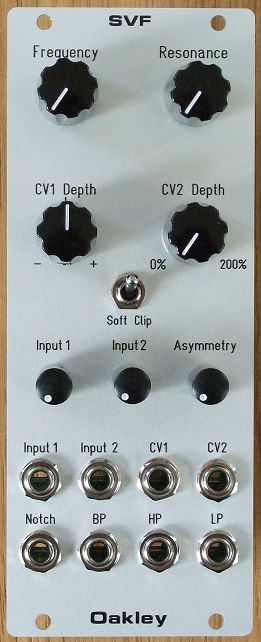
The Oakley SVF is a 10HP wide two stage
multimode filter module capable of high pass, low pass, band pass
and notch output modes. All four outputs are available
simultaneously. The module is a stand alone version of the filter
in the Oakley ASV 5U module which is based around the classic two
pole state variable filter topology as used in a variety of
vintage synths including the Oberheim SEM and OB-X.
The module has two audio inputs, each with
its own mini level control, which are mixed together before being
sent to the filter core. The mixer can be operated in either ‘clean’
or ‘soft clip’ modes. Clean mode will simply mix the signals
together and feed them cleanly into the filter core. Soft clip
mode will gently limit the maximum voltage output of the mixer
rounding off the top and the bottom peaks of the audio signal. In
soft clip mode the asymmetry control allows you to force the
mixer’s output harder into the negative soft clipping zone
distorting the audio in an interesting way.
The module requires +/-36mA at +/-12V.
The PCB set
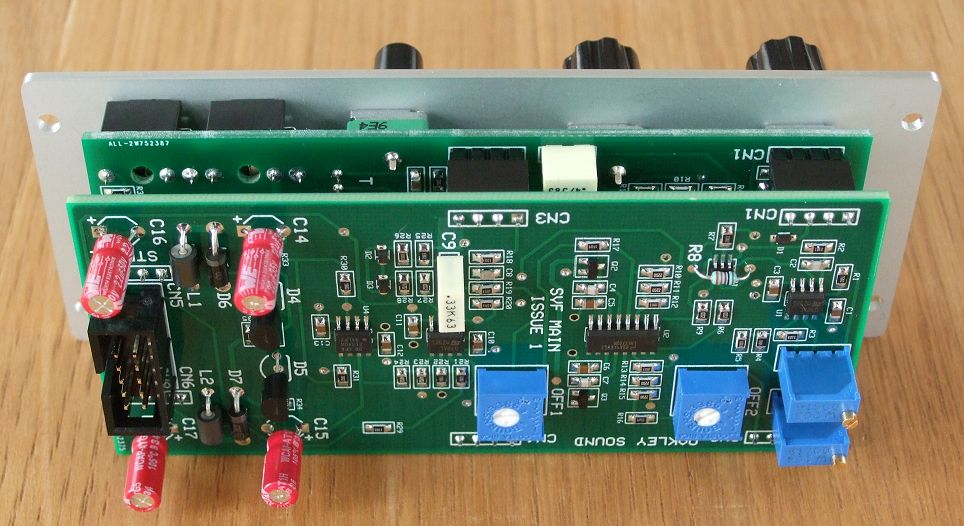
The SVF module comprises of
two printed circuit boards (PCBs) connected together with six 0.1
(2.54mm) single in line (SIL) headers and sockets. The main board
on the rear of the module houses the power input and conditioning,
the filter core, exponential convertor and output circuitry. The
pot board has the pots, switch, and sockets that are attached to
the front panel, as well as the mixer, soft clipping circuit, and
CV summing circuit. The main board is a four layer design, while
the pot board is a two layer design. Each board is the same size;
49 mm x 107 mm.
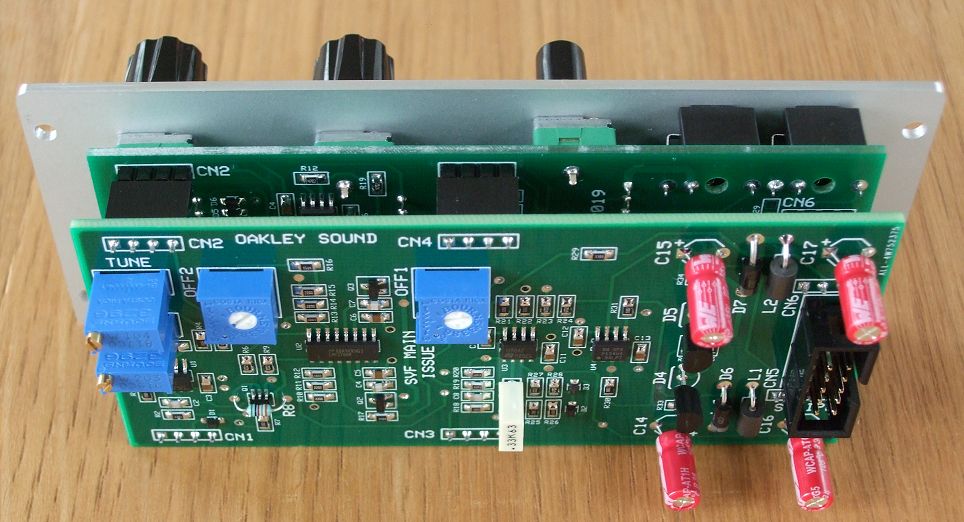
The
majority of the components are surface mount parts. The ICs are
SOIC, and the resistors and surface mount capacitors are 0805.
The two transistors are SOT23, and the PNP matched pair is a SOT457.
All components are standard parts.
Sound Samples
Two droning sawtooths from an
Oakley DVCO being fed equally into the SVF module at fairly high
resonance. The SVF’s cut off is modulated by a decaying sweep
from an Oakley ADSR and the output of an eight step sequencer.
Reverb and some light echo adds to the ambience.
A simple eight step sequence
modulates both the pitch of the DVCO’s two oscillators and cut-off
frequency of the SVF. The second channel of the sequencer and an
Oakley Envelope modulates the filter’s cut off frequency. The SVF’s
pots and Envelope’s decay time is manually altered as the sample
progresses. Near the end of the sample one of the VCOs is tuned
up an octave and a bouncy delay is added.
The same sequence as before
and again the SVF’s cut-off, resonance, and CV depth pots are
manually altered to show the variation of tone that can be
acheived.
Project Downloads
Construction
Guide Our handy guide to building
Oakley DIY projects
Parts
Guide Our handy guide to buying
parts for Oakley DIY projects
Schematics are only available
to purchasers of the PCBs and will be sent via e-mail when the
boards are shipped.
Front Panel database
A Schaeffer front panel can be made for
this module. The database can be found by downloading the
following link:
10HP Eurorack format
in natural silver
To read, edit and print these
files you will need a copy of ‘Frontplatten Designer’ from Schaeffer. Panels can be ordered via the program using its
secure online ordering system.
Schaeffer are based in Berlin, Germany and
can send panels to anywhere in the world. Delivery to the UK
normally takes around ten days. For North American users you can
also order your Schaeffer panels from Front
Panel Express.
Back to Eurorack projects page: Projects
Back home