
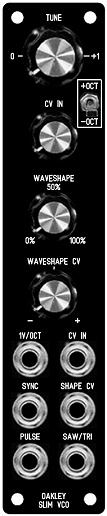
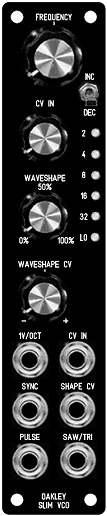
The suggested panel designs for the SVCO-A
(left) and SVCO-B (right) single width voltage controlled
oscillators.
Two compact well specified audio VCOs for
MOTM and MU based modular synthesisers.
The ‘A’ variant has a single tune control
and three way octave switch. While the otherwise identical ‘B’
variant has an inc-dec switching system (with three way momentary
switch and LED ladder display) to allow for easy control over
five octaves and a wide range LFO setting.
SVCO-A modules are built with just the SVCO
main board. The B variant uses the same SVCO main board with an
additional SVCO-B daughter board that attaches to the main board
via a tidy 10-way ribbon cable.
Both variants have a variable width pulse
wave as well as a sawtooth waveshaper to generate a fully varying
shape from ramp through triangle to sawtooth.
The SVCO uses a sawtooth core but with a
different topology than our existing double width VCO. Hard
synchronisation is possible from an external VCO. Expansion to a
double width module would be possible to allow for further input
and output capability.
To allow all the functions required by this
module we have had to reduce the spacing between the pots.
Instead of our usual 1.625″ (41.3mm) we have opted for the
smaller 1.375″ (34.9mm). Used in conjunction with smaller 20mm
(13/16″) diameter knobs this still allows for an attractive
module design and finger friendly tweaking.
The module accommodates either our standard
Oakley/MOTM power header or a Synthesizers.com power header.
Current consumption is approximately +40mA and -35mA for the SVCO-A,
and +47mA and -38mA for the SVCO-B.
In LFO mode the SVCO-B’s tune pot will
operate over a range of 0.01Hz (one cycle every 1.5 minutes) to
500Hz.
The main SVCO PCB is 10.9cm (deep)
x 12.3cm (height). As with all Oakley projects both PCBs are
double sided with through plated holes, have tough solder mask
both sides, and have bold component legending for ease of
construction.
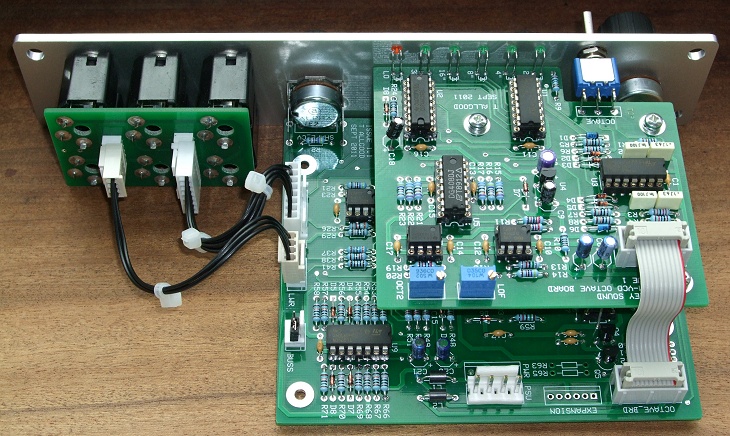
The prototype SVCO-B fitted to a natural
finish Scheaffer panel. This shows the SVCO-B octave board
mounted above the SVCO main board. A 10-way IDC interconnect
carries the various signals and power between the two boards.
Note also the use of the optional Sock6 socket board to help keep
the wiring to the sockets neat and tidy .
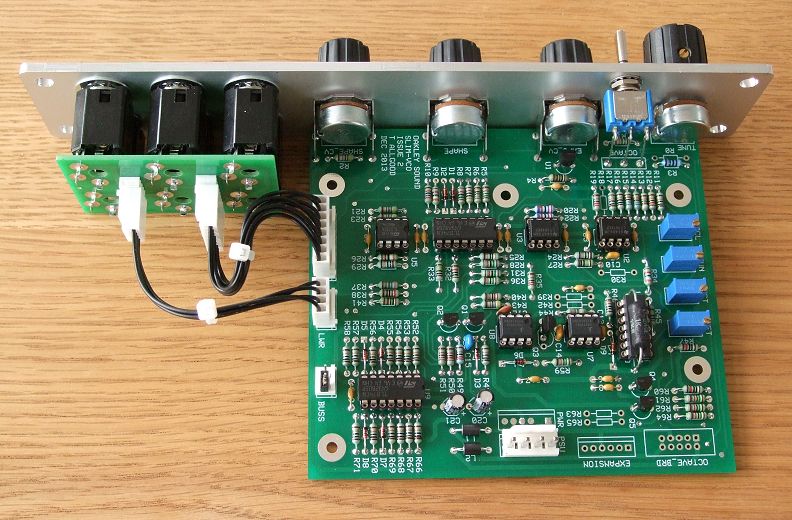
The SVCO-A module in a natural finish
Schaeffer panel. To build the SVCO-A module you only need the
SVCO main board. Note again the use of the Sock6 to make wiring
the panel sockets so much easier.
Project Downloads
SVCO-A
Issue 2 Builder’s Guide
SVCO-B
Issue 2 Builder’s Guide
Construction
Guide Our handy guide to building
Oakley DIY projects
Parts
Guide Our handy guide to buying
parts for Oakley DIY projects.
Schematics are available to
purchasers of the PCB or module and will be sent via e-mail when
the board(s) are shipped.
Front Panel database
A Schaeffer front panel can be made for
this module. The databases can be found by downloading the
following links:
5U format 1U wide
SVCO-A module in traditional black
5U format 1U wide
SVCO-B module in traditional black
5U format 1U wide
SVCO-A module in natural finish
5U format 1U wide
SVCO-B module in natural finish
To read these files you will need
a copy of ‘Frontplatten designer’ from Schaeffer. The program also features on-line ordering, so it’s
easy to buy your panels from Scheaffer.
The company are based in Berlin in Germany
and will send out panels to anywhere in the world. Delivery to
the UK normally takes around ten days. For North American users
you can also order your Schaeffer panels from Front
Panel Express.
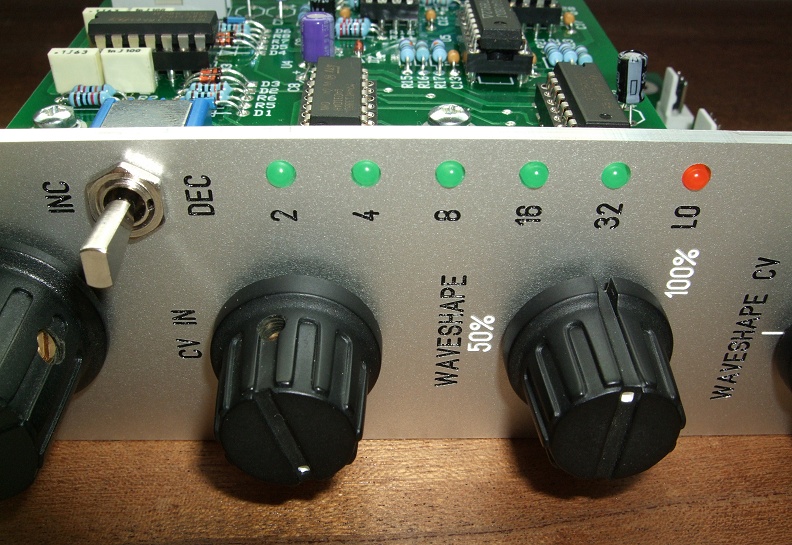
The INC/DEC switch allows you to switch
between five octaves or put the unit into the LO mode whereby the
SVCO-B behaves as a wide range VC-LFO module.